
Why is Monopoly so frustrating?
Psychologically speaking

My master’s thesis was about why people play board games. In short, I determined five big reasons:
Autonomy: a need to feel that we make decisions that matter
Competence: wanting to feel like we are good or at least improving
Relatedness: wanting to belong
Novelty: a need to engage in new experiences
Aesthetics: enjoying the beauty of a theme of a game
The first three are from a huge motivational theory called self-determination theory—very popular. And they were kind of expected, while the other two were not.
Monopoly
To grasp the nebulous words above and make them concrete, imagine Monopoly (again). You were looking for something novel, something you hadn’t played before, so you picked this game. The stage is set with aesthetics, the theme of the game. This specific theme creates a context of capitalistic ambivalence. It’s about property and rent, and ultimately about achieving a monopoly thereof. This will affect the interpretation of the basic needs. Competence, feeling capable and succeeding, is the most simple to understand; when we win, we feel pretty good. Buying properties and getting rent, watching our wealth grow is satisfying that need because it is a proxy for our competence. Winning is the ultimate satisfaction of that need. Autonomy is about making our own decisions, so picking which investment and how to make them. Relatedness, the desire to belong, is not satisfied directly in the game, but through the game by talking, joking, and sharing the experience together. Yes, joking and laughing merrily into the sunset.
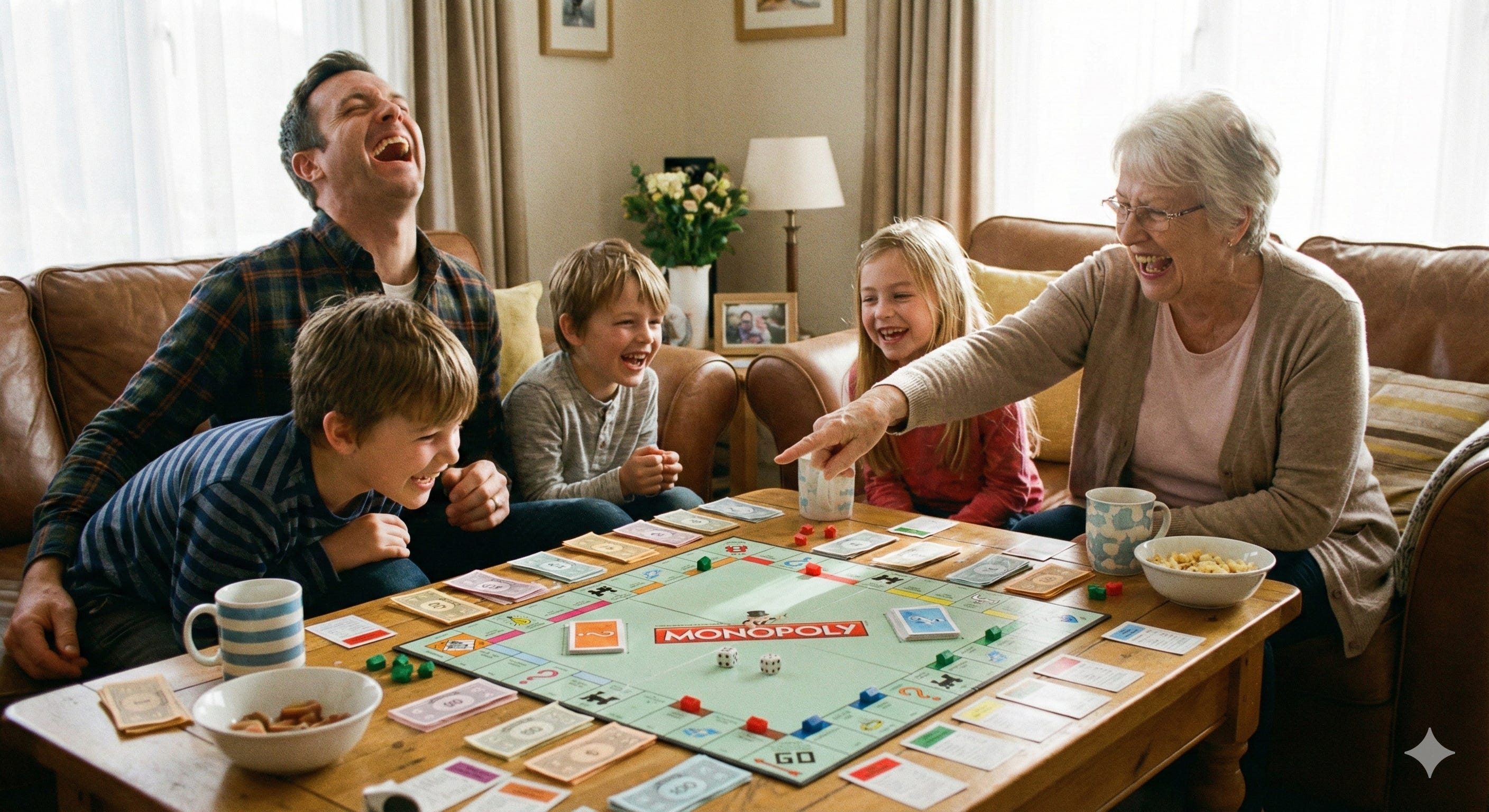
However, after sunset follows the long night. And if you have ever played Monopoly, you know there comes a turning point where fun turns into drag for all but one player. When that player starts actually approaching monopoly, tensions rise because the basic needs start to get frustrated. First out of the window is autonomy. You start feeling like there is nothing you can do, that you don’t have a choice. You roll the dice, and you do your steps and end up on an occupied field more likely than not. Ironically, jail becomes the most liberating field for sparing you three whole turns of landlord terror. Be that as it may, it’s becoming repetitive by now, even if you weren’t getting destroyed. The reduction of novelty leads to an increase of boredom. Next is competence, you feel like a failure. While the rich get richer, you keep paying and see your wealth dwindle. Finally, relatedness suffers because you start resenting the winner. Maybe you start throwing the money in the winner’s general direction, maybe you silently hate them for being happy that they’re winning, or you wonder why you agreed to play in the first place. This was your first time playing, it was very exciting at first but lost its appeal towards the end. The novelty has completely worn off and you can’t imagine other playthroughs to unfold differently, unless you really luck out.
Let me know if that sounds about right.
What do they mean for game designers?
So what? The mountain of evidence supporting self-determination theory grew by another pebble. Why should you care?
Games, not just board games, are inevitably going to tap into the three basic psychological needs, not because we designers are conscious of them, but because they make up the human experience for which we design. We will try to tap into them anyway, so understanding them will help us adjust mechanics and game feel to crank up the satisfaction (or frustration) of the needs as…needed. All for the purpose of making it more fun!
Autonomy
“Games are things that respond to the agency of a player.” - Gabe Newell
I’d say the fundamental need is autonomy judging by the literature as well as common sense. The tacit assumption in games is that player actions matter in some way, otherwise why would they play? But if they are forced to play in a certain way or they don’t have a choice, meaning they are affecting the game but it’s “not really them”, they drop the game. Alright, so we should give control to players, duh. But be careful not to equate control with options. You don’t need infinite options to create a sense of autonomy, sometimes just two options suffice. In fact, too many might make it too hard to decide.
Competence
“Fun from games arises out of mastery.” - Raph Koster
Competence in games is usually worded from the perspective of “difficulty” or “challenge”. If you aren’t challenged, you can’t demonstrate competence. So if the game is too hard, we drop it, and if it’s too easy, we drop it, too. We need the perception that we are good or at least getting better. Soulslikes became popular for their difficulty, cookie-clickers for their easy rewards. So there doesn’t exist an objective so-called “sweetspot” for games, and difficulty can be an artistic choice. However, you can increase playtime (read “perceived fun”) through satisfying the need for competence. Jenova Chen’s game Flow is directly based on the psychological state of flow, where players can go to easier areas if it became too hard and vice versa. Said differently, players get to calibrate their own difficulty to figure out their personal sweet-spot. It works, I played it.
Relatedness
“Games should not be entertaining. Games should make the people you’re playing with entertaining.” - Elan Lee
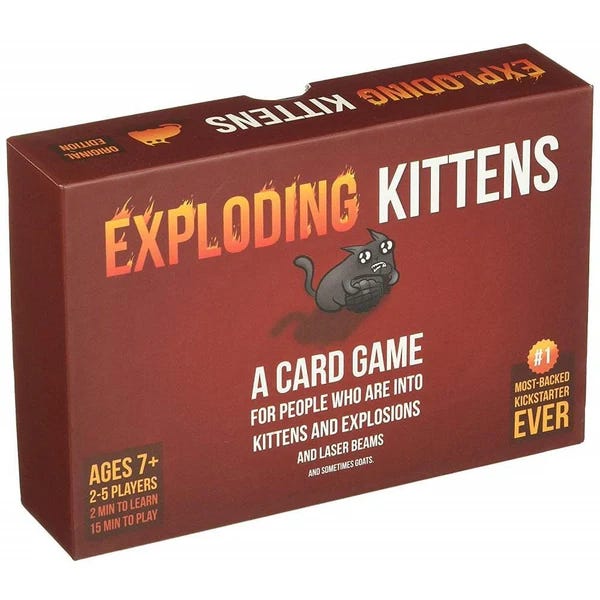
While the first two needs are required for a game to be a game, I would say that relatedness is not. There are solo games, after all. However, board games are inseparable from the idea that you’re playing with others. You don’t think of solitaire when I say board game. The creator of Exploding Kittens, Elan Lee, approaches games as a medium for people to interact. His design philosophy is really about facilitating relatedness. So while it’s not required per se, it’s definitely helpful. Also, look at Steam’s best-sellers this year with the rise of “friendslop” games, which are unpolished games you get to play with your friends. These all tap into that need.

Novelty
No quote for this one to break the pattern and create novelty.
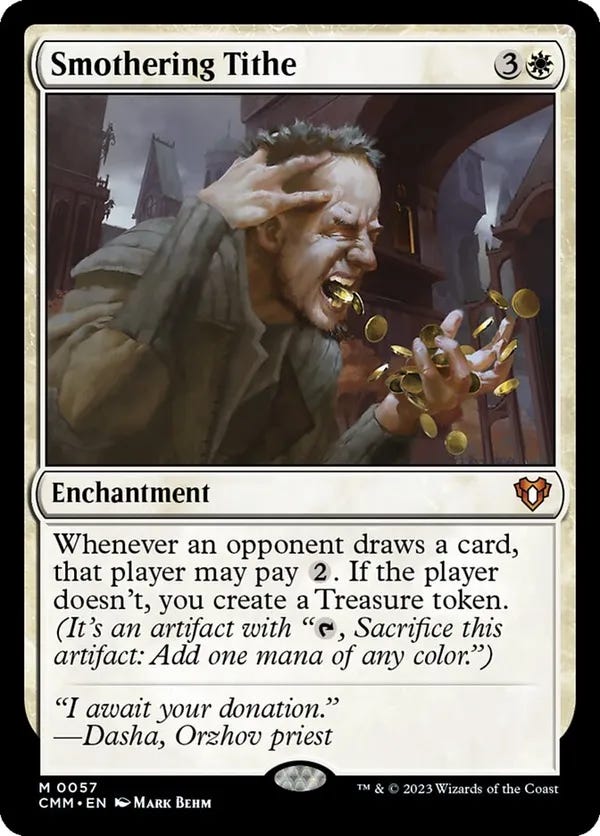
Also, it’s a tricky one. Self-determination theory researchers are screaming at each other about its classification as a fundamental psychological need. I don’t think it is one of the OGs. I look at it this way: we always, always want to feel in control, proficient, and feel like we belong. Experiencing something new, on the other hand, can be exhausting and sometimes we’ll outright avoid it. To me, novelty is more of a mechanism which facilitates the other needs, primarily competence. If you have done the exact same thing enough times, it will stop being a challenge. A new situation is a challenge to which we react and prove our competence. It’s everywhere in games: drawing cards, rolling dice, random level generation, packs, loot boxes, your opponent’s moves, and so on. Many mechanics contain an implicit element of surprise in them.
Aesthetics
“Failure to satisfy aesthetics makes players feel ill at ease … and makes them pay attention to what your game isn’t instead of what it is.” - Mark Rosewater
As Rosewater says, you must pay attention to aesthetics. It needs to be beautiful and it needs to fit together sensibly, it needs to feel right. But that’s only part of the picture I’m trying to paint. In my thesis, aesthetics was both feel and context. I think this combination, feel and context, is the most important one for us game designers to get right because defining the context through the theme changes how we interpret the events that take place.
Monopoly revised
To illustrate what I mean, let’s revisit Monopoly. We’ll start with only the aesthetics. So you still roll the dice, get to invest, and have to give resources to others for their fields. Then we’ll change those to support the needs. Now, maybe the whole point of Monopoly is to intentionally frustrate us to show how bad monopolies can be. So I’m not trying to “fix” the game, just show how little is needed to change the whole thing.
Phase 1: Re-skin (aesthetics)
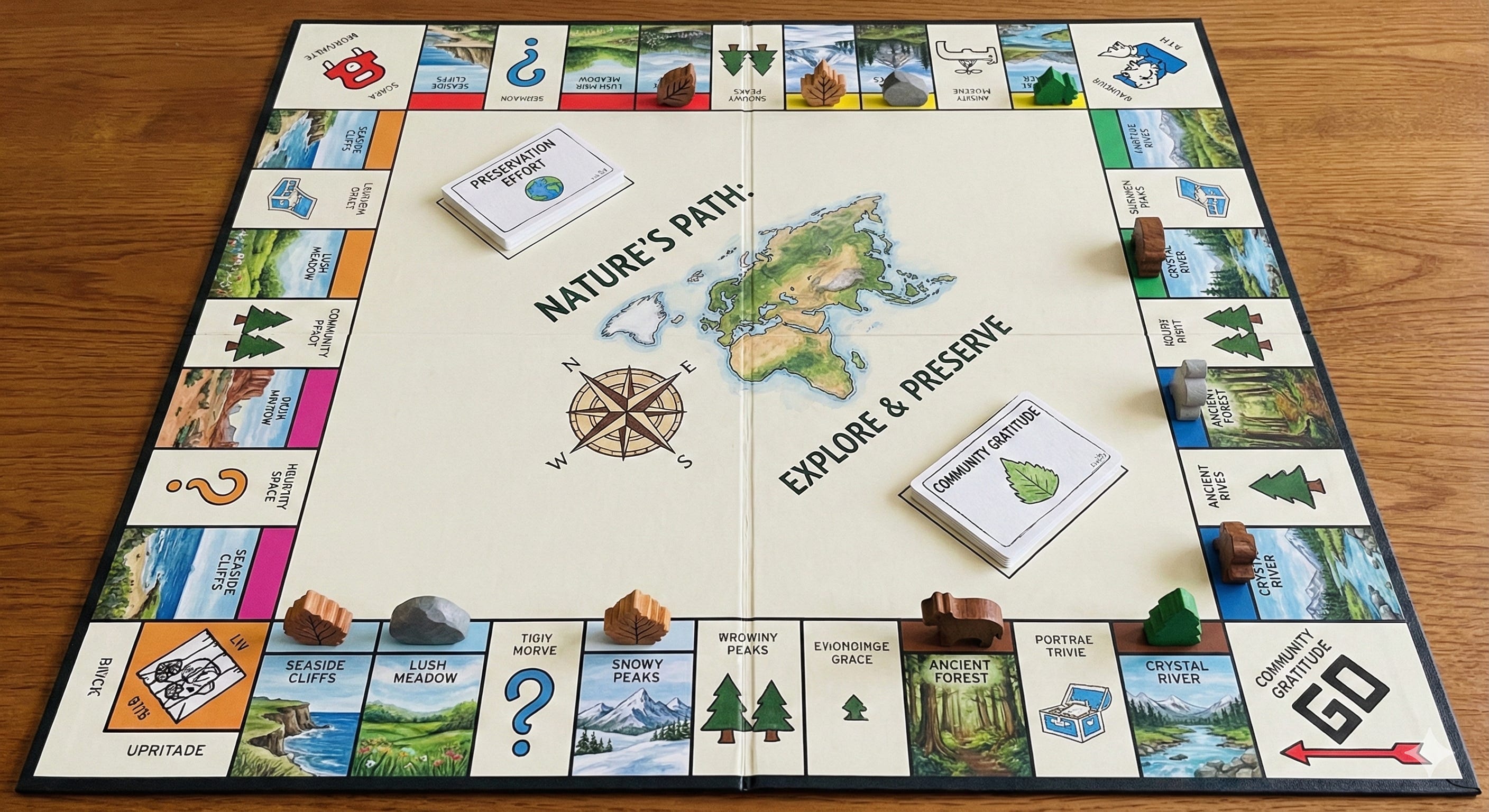
Let’s go from capitalistic greed to something more mellow, more soothing like the beauty of nature. We are now brave explorers of a novel continent instead of a monocle with a mustache. Rolling is just throwing the dart on the map so to speak; we’re just picking where to go randomly to enjoy nature. Each field is a beautiful vista: seasides, lush greenery, snowy mountain ranges, etc. These need to be protected. So we invest effort (instead of money) into the preservation of these locations. The first player who decides to preserve it bears the brunt of the effort, and the others support them every time they step on it by giving the player their effort to allocate as needed.
Let’s go through it mentally for a second. Imagine you rolled up to a location to enjoy the view, and have to give your effort to another player who can then reinvest it to improve and preserve the beauty of that location. We haven’t changed the mechanics, it’s the same as stepping onto a property so you can stay there and paying the landlord to improve and maintain their buildings. But it feels different. The same actions lead to a different interpretation that doesn’t frustrate the basic psychological needs.
Phase 2: Revise (the basic psychological needs)
Now, let’s actually change the mechanics to support the psychological needs a bit more.
We add an option that allows you to spend effort to adjust your movement. For example, you roll a 5 and get to spend 100 effort for every extra field you want to move in any direction. You now feel more in control, more autonomy, of where you end up.
We also allow players to turn maxed out fields into public property in exchange for a token of gratitude. After making it public, nobody can own that property and no one has to pay. Now we would have a new measure of success which is primarily altruistic, which feels better to all those involved.
Instead of getting other players’ effort, that player now gets high fives every time someone steps on it. Look at this touching display of bonhomie, a stirring sense of belonging washes over us. Whoever has 5 tokens of gratitude says namaste and wins the game. Victory is no longer dependent on driving other players to ruin (and playing for 3 hours straight), but creating public good.
And there you have it. Whipped up a Monopoly-killer in like two paragraphs. Well, it might not have the intended effect at all. As always, that’s all for playtesting to determine, but looking from the perspective of fundamental needs can be a useful diagnostic tool. Most designers will be aware, but just in case someone is not: psychology is surely useful in game design, but don’t learn psychology before designing. Practice designing games first, then fill gaps in understanding with psychology (and sociology, and math, and biology, and so on). Try it out and let me know.
Bonus read: How did I get those five motivators?
Don on your lab coat and strap on your goggles, we’re getting into science-grade facts. This is technically the only part that matters since every conclusion rests on the method.
We decided on a qualitative analysis for exploration since there hadn’t existed much research on this specific topic. I approached it from an exploratory angle without a hypothesis. To gather that qualitative data, I conducted a couple of focus groups where I let the participants discuss their motivations over cookies and iced tea (N=9). The method to conjure clarity from that chaos is called thematic analysis. The idea is to ask open-ended questions, and let the participants discuss among themselves, while moderating it (so that everyone gets to share their views). After that, we try to figure out the recurring themes in the discussions by reading and highlighting the transcripts (it takes much longer than you would expect). While I didn’t have a hypothesis, I did have an assumption: they would probably mention the three basic psychological needs--you know, because they’re fundamental. Therefore, I was already looking for those, but I was ready to drop them if they didn’t appear. In a shocking twist, they actually did, although there were some themes that just didn’t fit in with them. They weren’t like the other kids on the block; they were weird, dodgy and smoking behind the school. People talked about the art and vibe and style of the game: aesthetics, the essence of subjectivity. They also talked about boredom and excitement: the hyperactive addict called novelty. These are just the names I gave the themes, I could have called them art or surprise, as well, but it did align with previous research in video games, so I borrowed their names.